

“The best time to plant
a tree was 20 years ago.
The second best time is now.”
– Chinese Proverb
The invasive Albizia, a profound purpose and opportunity for the building industry
The Albizia and other invasive tree species here on Kauai hold a profound and revolutionary piece to the sustainability of our island. The abundance of quality material is seemingly endless, and by utilizing what is here we can make room to restore Kauai’s natural habitat.
The term “invasive species” refers to plant specimens that reproduce quickly and outplace native species, thus threatening our environment, economy, agriculture, human health, and overall quality of life. As government agencies are doing what they can to control the spread of these plants, each of us has the opportunity to help. S.O.L. Projex is driven by creating dynamic solutions for supposed problems.
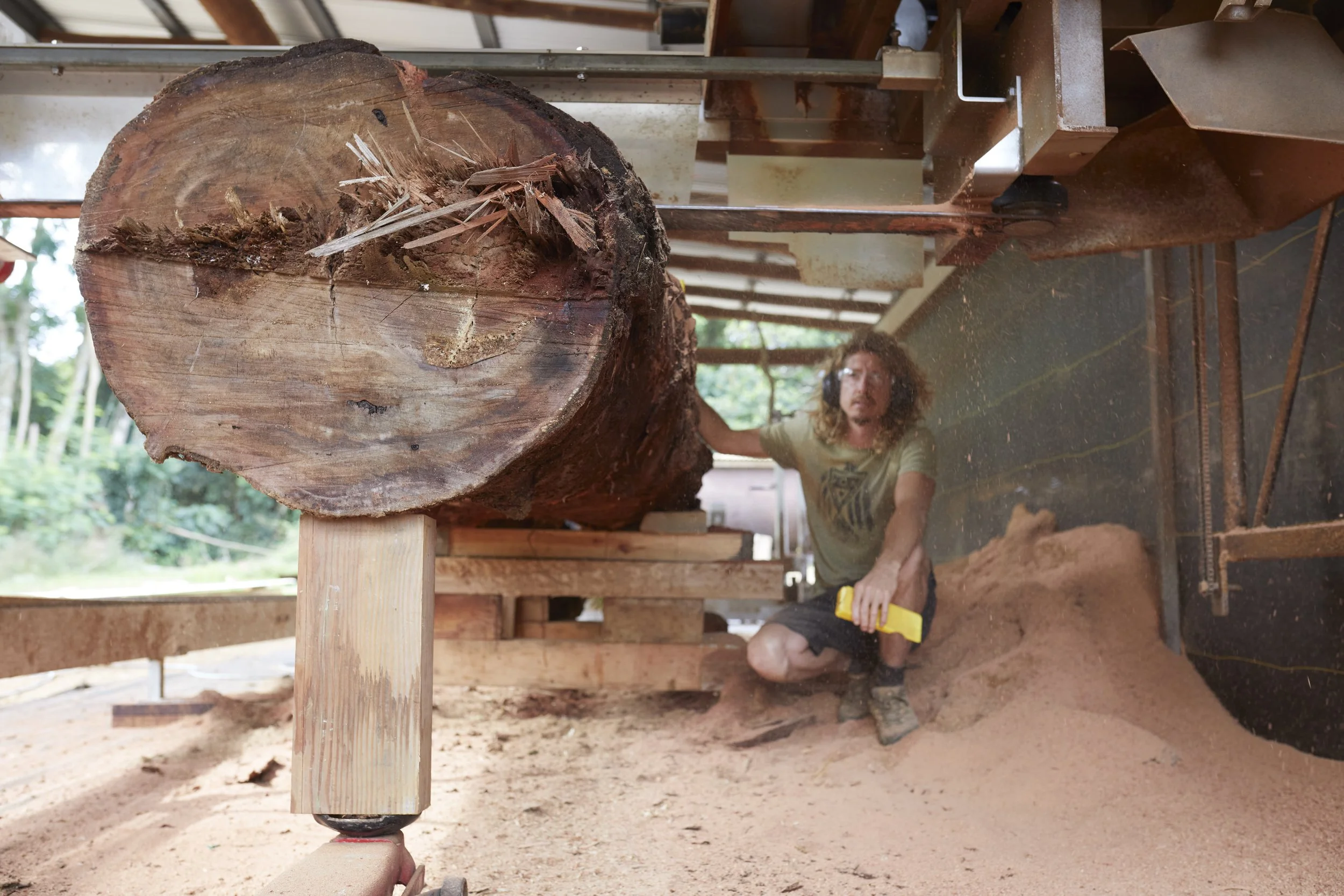
Remove the invasives, give them another chance at life, and transform them into locally sourced forestry products, milled lumber, biochar, wood fiber, and natural building materials, that serve the residents of Kauai while supporting ecological restoration and island resilience.
The Albizia has been studied by the University of Hawaii to be structurally sound as a building material. We are researching how Albizia and other local species can replace imported timber in building applications, developing a replicable model of invasive-species utilization and forestry product processing that other island communities can adopt.

Jungle Restoration, harvesting with reverence.
A main component of our project is the restoration of Kauai’s natural habitat. As trees are cut down to be milled, others will be planted. Hardwood fruit trees and fruit forestry will bring more balance and abundance to the land for now and future generations to come.
Our plan is to remove 175 trees, mulch 1/3 of these trees, and return the material back into the ground, where the carbon will be stored in the soil as soil organic matter (SOM). We will then be replanting 250 trees and 1000 plants and shrubs. A natural and organic food forest with an abundance of biodiversity has been studied to store significantly more carbon in the soil.


We utilize small fallen limbs and mill offcuts to produce biochar through our on-site kilns as part of our soil and biochar systems research. We estimate annual production of 30 tons of biochar material, capturing approximately 650 tons of stable CO₂. This stable carbon is sequestered into the soil, improving water retention, nutrient diffusion, and long-term soil health, directly supporting our regenerative agriculture and soil-building work.

